

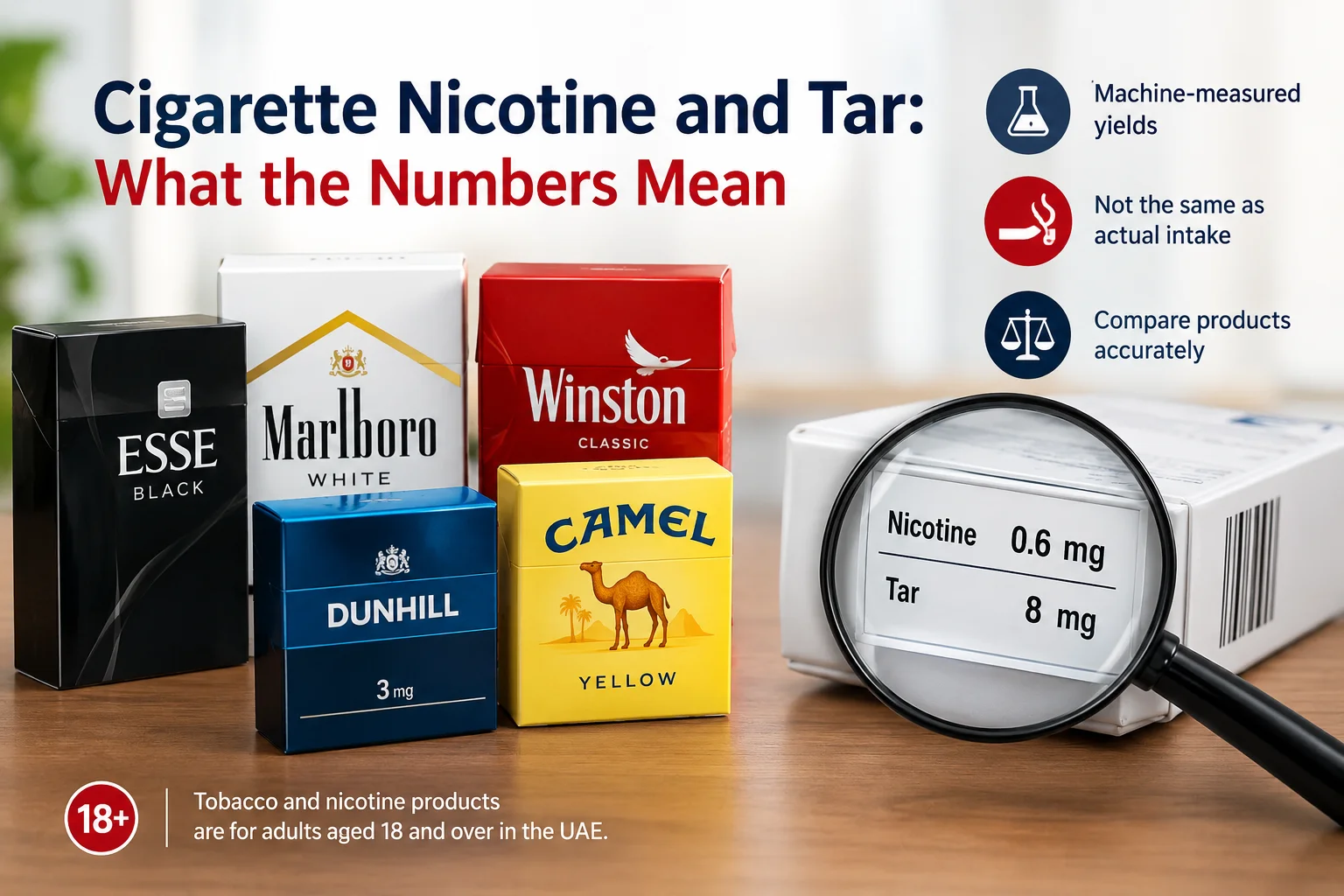
Cigarette nicotine and tar numbers are usually presented as machine-measured yields, giving smokers a standardized way to compare the figures printed for different cigarette products. These numbers can vary by product and are not the same as the amount an individual smoker actually absorbs.
Cigarette products can have different labeled nicotine and tar figures depending on the brand, variant and market. The exact figures should be checked on the specific pack being compared.
Quick answer: Nicotine is the addictive substance naturally present in tobacco, while tar refers to the particulate matter measured in cigarette smoke. The nicotine and tar figures printed on cigarette packs are standardized machine-test results and do not represent the exact amount a person will absorb when smoking.
What do nicotine and tar numbers on a cigarette pack mean?
Nicotine and tar figures are commonly shown as yield measurements produced under standardized smoking-machine conditions. They provide a consistent way to compare labeled product specifications, but they do not predict exactly how much nicotine or smoke constituents a person will take in.
Smoking behavior can affect actual exposure. Puff volume, puff frequency, smoking duration and other factors can change how much smoke a smoker inhales.
For that reason, a cigarette with a lower machine-measured yield should not automatically be considered a safer cigarette.
How much nicotine is in Esse Black?

Esse Black Cigarettes are one of the products commonly compared when shoppers are looking at cigarette strength and labeled nicotine information.
The exact nicotine and tar figures should be taken from the specific pack and market being sold because product specifications can vary between versions and markets.
If you are comparing Esse Black with another cigarette, use the nicotine and tar information printed on the respective packs rather than assuming that the product name alone indicates a specific yield.
View Esse BlackHow much nicotine is in Marlboro White?

Marlboro White Cigarettes are positioned as a smooth and mild cigarette option in the product range.
When checking nicotine and tar, use the figures printed on the exact Marlboro White pack available in your market. Product specifications can differ between markets and product variants.
A lower labeled nicotine yield does not mean that a smoker will necessarily absorb less nicotine during actual smoking.
View Marlboro WhiteHow much nicotine is in Winston Red and Winston Blue?

Winston Red Classic
Winston Red Classic Cigarettes are a full-flavor Winston product commonly compared with other Winston variants.
For an accurate nicotine or tar comparison, check the printed specification on the exact Winston pack rather than assigning a numerical value based only on the Red or Blue name.
View Winston Red ClassicWhat does Dunhill 3mg mean?

Dunhill 3mg Cigarettes use the 3mg designation as part of the product’s labeled specification.
The number should be understood in the context of the product’s stated measurement and testing method. It should not be treated as a guarantee of the amount of nicotine an individual smoker will absorb.
If you need to compare Dunhill 3mg with another product, compare the complete printed specifications from both packs and make sure the products are the same market version.
View Dunhill 3mgIs Camel Yellow stronger than Camel Blue?

Camel Yellow Cigarettes and Camel Blue are different variants, and their labeled specifications can differ depending on the market.
Rather than assuming that Yellow or Blue represents a fixed nicotine or tar level worldwide, compare the information printed on the specific packs.
Machine-measured nicotine and tar yields also should not be interpreted as a direct measurement of personal exposure.
View Camel YellowWhy can nicotine and tar figures differ between packs?
Nicotine and tar figures can differ because cigarette products are manufactured in different variants, markets and specifications. Packaging can also differ between countries.
When comparing products, check the exact pack rather than relying only on the cigarette name.
- Check the exact product variant.
- Check the market or country version.
- Read the nicotine and tar information printed on the pack.
- Compare equivalent measurements when reviewing two products.
How do you compare cigarette strength?
A simple comparison starts with the labeled information on the exact products you are considering.
- Identify the exact product. Check the brand, variant and pack version.
- Read the printed nicotine figure. Use the value stated on the specific pack.
- Read the printed tar figure. Compare the corresponding measurement rather than using product names as a substitute.
- Check the market version. Product specifications can differ between countries and markets.
- Do not treat machine yields as personal intake. Actual exposure can vary with smoking behavior.
A plain health note
Nicotine is addictive, and smoking tobacco carries serious health risks. Cigarette nicotine and tar numbers should not be used to identify a cigarette as safe or harmless.
Lower machine-measured yields do not mean that smoking is safe. Actual exposure can vary depending on how a cigarette is smoked.
Shop by brand
Explore cigarette products by brand and compare the exact product information available for each pack.
5 thoughts on “Cigarette Nicotine and Tar: What the Numbers Mean”